
Tension, Edges and Traction Alopecia
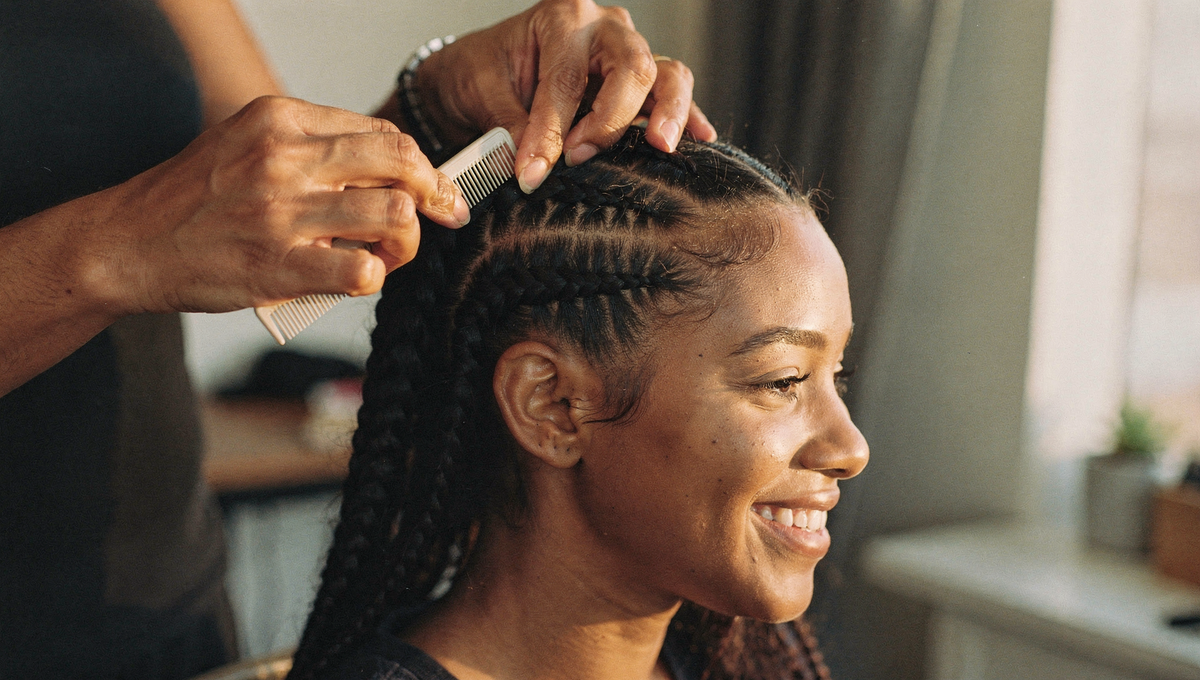
Every Braid Artist has heard a client say "make it tight so it lasts." The research is clear that tension is the thing most likely to cost a client her edges, and that early damage can often be stopped. Here is what dermatology sources actually say, and what that means for how you work in the chair.
What traction alopecia is
Traction alopecia is hair loss caused by repeated pulling on the hair. The American Academy of Dermatology (AAD) says anyone who wears tight styles or puts repeated stress on the scalp can get it, and that girls and women of African descent are affected more often, partly because tight styles are common and partly because the shape of the hair follicle can make the hair more prone to damage.
The key thing to understand is that it happens in two stages. A 2018 review by Billero and Miteva in Clinical, Cosmetic and Investigational Dermatology describes an early stage of non-scarring hair loss along the areas under tension, which can progress to irreversible scarring if the traumatic styling continues. The NIH's StatPearls reference puts it the same way: early disease is non-scarring and reversible, while long-term traction can permanently damage the follicle's stem cells.
In plain terms: catch it early and the hair can often come back. Keep pulling, and it may not.
Which styles and practices carry the most risk
Dermatology sources point to the same handful of factors: how tight, how heavy, how long, and what condition the hair is in underneath.
- Tight braids and cornrows. The AAD lists tightly braided hair, cornrows and locs among the styles that can cause traction alopecia.
- Extensions and weaves, especially on relaxed hair. A Johns Hopkins review published in the Journal of the American Academy of Dermatology classed braids, locs, weaves and extensions as high risk, especially when they are put on chemically treated hair. Billero and Miteva cite a simple rule from dermatologists Mirmirani and Khumalo: no braids or weaves on relaxed hair.
- Weight and length. The AAD advises thicker braids and locs and keeping them shorter, because longer hair is heavier and pulls more on the root.
- Time. Billero and Miteva note that both the amount of pulling and how long it lasts raise the risk.
- Glue. The AAD prefers sewn-in weaves over bonding glue, and the Johns Hopkins review lists adhesive-glued extensions as a risk.
Early warning signs you can see in the chair
You often see a client's scalp more closely than anyone else does. That makes you the early warning system. The AAD and the medical literature describe these signs:
| What you notice | What it can mean |
|---|---|
| Client says it hurts, stings, or she needs pain relief after an install | The AAD is direct: if a style feels painful, it is too tight. |
| Small red bumps or pus bumps around follicles at the hairline | Inflammation from pulling. Both StatPearls and Billero and Miteva describe redness around follicles developing into bumps. |
| Scalp lifting up in little tents where the hair is anchored | The AAD names "tenting" as a sign of tension. |
| Broken hairs around the forehead | Listed by the AAD as an early sign. |
| Thinning or a receding line at the temples and around the ears | The AAD says a receding hairline is often the first visible sign. StatPearls notes loss usually starts at the temples and in front of the ears. |
| A thin strip of short, fine hairs left along the very front edge | Called the "fringe sign," described in StatPearls and in the Billero and Miteva review as a clue to traction alopecia. |

Chair habits that lower the risk
None of this means you stop braiding. It means you build habits that let clients wear braids for years without paying for it with their hairline.
- Consult before you part. Ask about pain after past installs, recent relaxers, and how long she usually keeps styles in. Look at the edges and temples in good light before you start.
- Ease off at the hairline. The AAD specifically advises loosening braids at the hairline. Leave the perimeter softer than the rest of the head.
- Go bigger and lighter. Thicker parts and shorter lengths put less weight on each root, per AAD guidance. Be honest when a client's natural hair cannot safely carry the length she wants.
- Space the re-installs. The AAD recommends wearing braids no longer than 6 to 8 weeks. The Johns Hopkins review suggests taking weaves and extensions out for a period after 6 to 8 weeks rather than going straight into the next install.
- Recommend rotation. Both the AAD and the Johns Hopkins review advise alternating tighter styles with looser ones and giving the hair regular breaks.
- Think twice about relaxed hair. Braiding or adding extensions on chemically relaxed hair stacks two risks together.
Kids in the chair
Children are not exempt. In a South African study cited by Billero and Miteva, traction alopecia was found in 8.6% of schoolgirls in their first year of school and 21.7% of those in their final year. StatPearls reports signs of it in 18% of African American girls studied between roughly 5 and 14 years old, and notes cases have been reported in very young children.
Billero and Miteva call for education aimed at parents of young children who wear braids and cornrows. For you, that looks like:
- Lighter tension and fewer, larger parts for little ones, with extra care at the edges.
- Skipping heavy extension hair on small heads.
- Telling parents plainly that crying from tightness is a sign the style is too tight, not something to push through.
- Sharing a realistic take-down date at pickup.
How to talk to a client, and when to refer
Clients often believe tight equals neat and long-lasting. Billero and Miteva quote a line from Mirmirani and Khumalo worth borrowing: "Tolerate pain from a hairstyle and risk hair loss." Keep it about her hair, not about blame.
- Describe what you see: "Your edges look thinner here than last time, and I see some little bumps."
- Explain the stakes simply: early thinning can often recover, long-term pulling can become permanent.
- Offer an option: a looser perimeter, a lighter style, or a break before the next install.
You are not diagnosing anything. Hair loss has many causes, and the AAD notes that stress and genetics can also play a part. When you see ongoing thinning, bumps, patches of loss, or a client in pain, suggest she see a board-certified dermatologist. The AAD says it is never too early to get hair loss checked, and a dermatologist can find the actual cause and offer treatment options.
THE BRAIDINGFEST ANGLE
There is no license telling Braid Artists how tight is too tight, so the standard is up to us as a community. Protecting a client's edges is part of the craft, and it is something clients notice and talk about.
- Make a scalp and edges check part of every consultation, and write down what you see so you can compare next visit.
- Let client reviews speak to comfort as well as looks. "No pain, edges intact" is a review worth earning.
- Keep learning. Share what works with other braiders at She Braids on Nov 22 at Epic Events Center in Rancho Cucamonga, so the whole community raises the bar.
This article is for education only and is not medical advice. If you or a client notice hair loss, scalp pain or bumps, see a board-certified dermatologist.
Sources: Hairstyles that pull can cause hair loss, American Academy of Dermatology · Traction alopecia: the root of the problem (Billero & Miteva, 2018), Clinical, Cosmetic and Investigational Dermatology · Traction Alopecia, StatPearls / NIH National Library of Medicine · Risky hairstyles and traction alopecia (Aguh and colleagues, 2016), Johns Hopkins University Hub
What do you say when a client asks you to braid it tighter, and what has worked to protect edges in your chair?

She Braids: The Braiders' Experience
Braid Artists get in free and pick up a Golden Tote at check-in. Guests: GA $35, VIP $65.
Get the Braid Report every Sunday
Celebrity hair, who's getting booked, trends and events. Free.